13 November 2014

What Makes a Book Good (and my favorites)

I'm a reader. I have six books on my nightstand that take turns being picked up. One of them is my Kindle, which has probably 10 unfinished books on it that also take turns. This may say more about my attention span than about my love for reading, but really I enjoy delving into several topics at once. Reading is a surefire way to keep learning . . . that is, if you've got the right books.

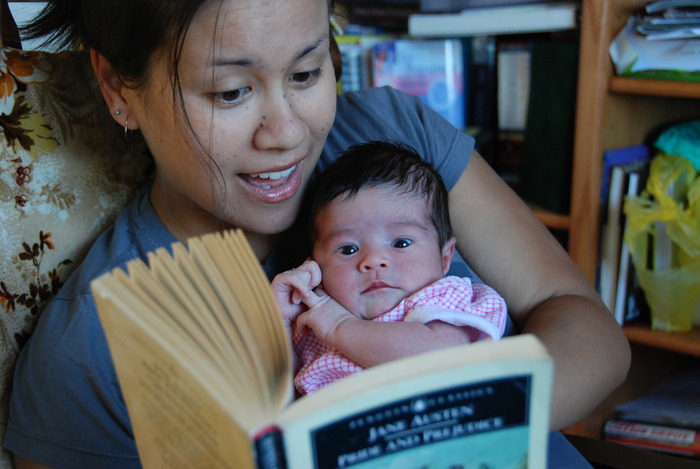
She may have been only a few days old, but my baby needed to learn the basics.

What makes a book good?
Oh man, that's an SAT question. Instead of arguing for my preferred genres, I'll categorize the basic bookshelf occupants:

Books that only entertain
Books that only teach
Books that teach and entertain

Books that invoke misguided emotions and betray morality
Books that reinforce right responses: joy in family, anger at injustice, etc.

Books that paint words as art
Books that structure grammar as science
Books that understand and respect grammar and use words artistically

Books that deceive by twisting truth, even if the content is light or spiritual
Books that speak truth, even if the content is dark or worldly

So the best combination would be . . .
books that teach and entertain, that leave you inspired and challenged, that wield the art of words, and that speak truth.

I have a lot of favorites that I believe embody this winning combination. I'm happy to share my top picks in several genres. You're invited to click on the links to read reviews I've written on Goodreads. (However, they probably all contain spoilers. You'd be better off just reading the books!)

Christian Teaching and Doctrine

The Gospel According to Jesus by John MacArthur

Biography and Memoir

Bonhoeffer: Pastor, Martyr, Prophet, Spy by Eric Metaxas
Booked: Literature in the Soul of Me by Karen Swallow Prior

Classical Fiction

Jane Eyre by Charlotte Bronte
To Kill a Mockingbird by Harper Lee

Cross-Cultural Fiction

The Poisonwood Bible by Barbara Kingsolver
A Passage to India by E.M. Forster
Caleb's Crossing by Geraldine Brooks
Cry, the Beloved Country by Alan Paton

If you'd like to know why I recommend these cross-cultural novels, I wrote a post about them on my other blog, At Home Abroad. You can read it here.


And if you'd like to read more book reviews, I'm on Goodreads! Find me there (by clicking on any of the book links above), and we'll be friends. ^^

03 October 2014

To Be Known

To be known
to be loved and heard
to be shown a soul
that welcomes my own--
in a word--whole.

To be trusted
to be taken in
to be dusted of pride
and humbly adjusted--
shaken--to confide.

To be blessed
to be washed undeserved
of a messy mistake
and cleansed with rest--
to be served--to take.

To be known
is my heart's desire.
Alone, I yearn
and thrash and groan--
and reach higher--to learn. . .

that

I am known
by My Maker
I am owned by His blood.
And I kneel at His throne--
overtaken by love.


(This post is part of a conversation at Velvet Ashes.) 

20 April 2014

Goodness through Easter

Eastertime is fun.

As a young girl, I would twirl in a new pastel dress with ribbons, carry my basket lined with plastic grass, and hunt for eggs in my grandparents' lawn. (My younger brother always got the most because the adults helped him.) It was a joyous family time of celebrating spring and eating chocolate--plus there was always yummy food at those  big family gatherings.

But how does all that fit in with the somber pictures of a cross and a tomb? My young mind separated the joy of Easter celebrations from the story of Jesus' resurrection. One was for the church service, and the other was for my grandparents' house.

And that's not how it should be. In my childish giddiness and caffeine-induced energy, I ran around and thought it was freedom. I bit into a Peep and thought it was goodness. I spun in front of the mirror and thought it was beauty. But all those things--freedom, goodness, beauty--originate in the resurrection and would not exist without it.

"Christ died for our sins . . . 
And was buried . . . 
and was raised on the third day 
according to the Scriptures," 
says I Corinthians 15:3-4.

Eventually, as an adult trying to explain Easter to my children, I began to realize what it really means. Jesus on the cross and the subsequent empty tomb are the turning point of history, the intersection of hope, and the reference point for faith.

Celebrating Easter may be fun, but Easter itself is . . . goodness. It's goodness because Jesus defeated evil when He (as a blameless substitute) suffered and died in the place of sinners. Then He defeated death when He came to life again on the third day.

So as I run around giddy with my children, dress them in their best, and munch unreservedly on seasonal treats, I can remember that all good things point to that Sunday morning when evil and death were defeated. It's when goodness was given to the world.


{This article was originally published in Naptime Reader, the newsletter for Seoul International Playgroup. You can view the entire newsletter by clicking here.}

18 April 2014

Glue: A Poem about Sticking Together

Forget the tape or velcro or string.
Give me glue.
I need others like I need air.
I need you--
to bring with you a mingling goo
that merges our souls into a pair.
With prayer and sharing
that verges on daring,
let's stick together
tenaciously,
committed whether we're
mismatched hues
or a knitted blend,
with love attached
vivaciously.
Glue me to you,
my friend.


Five Minute Friday

15 April 2014

The Fog Doesn't Dull the Moon

Facebook was raging tonight with reports of the beautiful red moon. My talented friend captured it like this:

PC: Sandra del Cid

Then I went out walking tonight because the house seemed loud. The kids were all in bed, and my husband was working on his computer, but the noise of my day echoed off the walls and my soul could not quiet down. It was a day full of arguments, bossiness, bullying, and whining. The kids couldn't seem to control their emotions or choose obedience. I also couldn't seem to control my emotions or choose grace. I felt like bursting.

My husband suggested I go for a run. My response: "I don't want to run. I want to punch something and scream."

But there was nothing here to punch that I wouldn't later regret, and there was no where to scream when you live in the middle of the city. So I did what I thought might help: took a walk while intending to knock out some errands and feel good about that. Well, shopping without kids did feel therapeutic until I couldn't find a part we needed to fix our broken toilet.  A rude storeowner finally tipped my coping scale, and I started to cry.

I didn't even bother wiping the tears away as I walked right past the roadway home and headed for the river instead. For thirty minutes or more, I sat on a bench staring out at the Han River. I let myself cry and cry and cry. I cried for my failures as a mom. I cried for my children's sins. I cried for the challenges of fixing a household appliance in a foreign country. I cried for the day without crying, when I made mistake after mistake, all the while wanting to start over but feeling buried and beaten and broken.

And through those tears I saw the moon.

It was full and high in the sky--above the city silhouette on the far side of the river. Its light barely broke through the thick grey fog that hung over Seoul and wrapped around me. "It's so dull," I thought. "It looks like how I feel."

Dull. Faded. Worn. Cold.

Then I remembered the photos I'd seen earlier online. That moon had seemed so much more alive, like a fire blazing warm and bold. "I wish I had that moon."

Then I stopped in my sad thoughts of self-pity. It was the same moon.

It was the same moon.

Because my heart felt lonely and lost, I craved the brilliance of a full moon--a symbol of illumination even in the dark of night. Yet I failed to remember that the moon shines the same regardless of how we perceive it. Fog or no fog, it still reflects light high above the extent of those clouds. To say the moon's light was shining less for me than for my friends in America would be like holding my hand over its image in my sight path and saying it suddenly disappeared.

The fog is there, but it doesn't dull the moon. The moon still lights the night.

And I think of how I'd thought the sad Seoul moon had mirrored my own droopy heart. Maybe my assumptions about hope and help are wrong too. Through my tears, I may look to heaven for comfort and yet not experience a breathtaking, photo-worthy answer, but it's not because heaven has lost any of its brilliance but rather because a fog has shielded my eyes.

God is God no matter how we perceive Him.

And He may seem far away or uninterested or even mean, but it is then--especially then--that I must read and remember the promises of His character in the Bible. Those verses serve as assurances of truth--just like the photos I saw tonight of the moon without the blocking of fog. Even if I can't see or feel it myself, I can be confident in what God is like because the Bible tells us who He is.

The moon may seem dull, but that is only because I skewed its description with circumstances.
Likewise, God may seem uncaring, but that is only because I skewed His description with circumstances.

"I am that I am," He said, so I must not fog the truth of His being or dull the brilliance of His beauty.

13 April 2014

The Difference between Hope and Want

Hope: a feeling of expectation and desire for a certain thing to happen; a feeling of trust
Want: a desire for something; a lack or deficiency of something

I use these interchangeably, and now I'm wondering if maybe I shouldn't. For what do I hope, and what do I want?

I could make a (choose the right word) quiz for myself to figure this out:

Hope or Want
1. that my children know Jesus (h)
2. that I look as good as my grandma when I'm 92 (w)
3. that the weather stays warmer (w)
4. that my husband's sickness goes away quickly (w)
5. that I can lose weight before my sister's wedding (w)
6. that I can be a good wife and mother (h)
7. that I can learn Korean phrases and speak to my neighbors (w)

Hmmm...it seems like my answers reflect this:
Hope is a desire of the heart, aligned with truth and promises.
Want is a yearning of my mind or body, birthed in insecurity.

I hope that my children know Jesus. I look at the Scriptures and see the power of discipling your own kids as commanded in the Torah and exemplified in Timothy's mother and grandmother. I teach them with the hope that they will see Jesus in all the Bible stories as well as in my life and my husband's.

I want to look good, be comfortable and healthy, and find success. However, these should not and cannot be put above the hopes guaranteed in the Bible's promises. When it becomes more important for me to get in a workout than to attend to my son's needs, there is a problem. When I become more attached to the feeling of safety than attuned to the voice of the Holy Spirit, there is a problem. When I start living my life according to my wants rather than my hopes, I will become a problem.

{My list above also shows me that it's much easier for me to come up with wants than hopes. I guess that means my mind dwells more on wavering, earthbound desires rather than truths from the Bible. I definitely need to work on that.}

So what then are my hopes? I see now I can rephrase that to this: "What are God's promises?" Here are three:

I hope to please God with my choices and with my life's direction.
"Trust in the LORD with all your heart And do not lean on your own understanding. In all your ways acknowledge Him, And He will make your paths straight" Proverbs 3:5-6

I hope for courage.
"For God has not given us a spirit of fear, but of power and of love and of a sound mind" 2 Timothy 1:7

I hope for peace in me and in my family.
"Be anxious for nothing, but in everything by prayer and supplication with thanksgiving let your requests be made known to God. And the peace of God, which surpasses all comprehension, will guard your hearts and your minds in Christ Jesus" Philippians 4:6-7

God's promises span all things that really matter. Therefore, I must hope for things that have true significance.

And my wants? I need to look at them and identify what insecurity makes me crave such things. Why do I want to look so good now and at 92? Well, it's because I don't want others to think I'm an unkempt housewife or halfway in the grave. It's because I'm vain and have the wrong perspective on physical beauty. It's because I'm childish.

Why do I want good health for me and my family? Hm, that's probably because I'm afraid of facing the difficulties of sickness, but I need to trust that God gives us trials for our good. He might allow sickness that would actually strengthen us all, and I shouldn't prefer convenience over growth.

Wants are natural, but I must hold them loosely. I must be ready to let them go at any time.

And tonight's question, which spurred this whole post: Why do I want so fervently for my daughter to learn to read before she enters kindergarten? The answer is that I'm afraid. I'm afraid she will fall behind her classmates or be teased or be frustrated. I'm scared that I've made the wrong choice to send her to school. And this fear is wrong because it's based on speculation and worry. It's a want--a very strong want--that may end up damaging our relationship.

What do I hope for my daughter?
Jesus.
And in Him grace, love, identity, compassion, joy, and peace.
But does my little girl know that this is my hope for her?
Do I put my hope above my want?

I will now.


{This post is part of a conversation on "hope" at Velvet Ashes.}
Here is a longer list of God's promises that I found helpful.

11 April 2014

Artbox: The Leftovers Syndrome

Leftovers.
It's what's for dinner even if I cook something new.
The kids finish, and I eat what's left on their plates.

Leftovers.
It's what's in my bathroom cabinet.
I finish his almost-squeezed-out toothpaste.
And I salvage the last drops of everything.

Leftovers.
It's what time I have for myself.
After everyone is fed and clean and smiling in their sleep,
I kick up my feet into a criss-cross-applesauce on my desk chair
to write and read and scribble and be.

Leftovers.
It's what's in our artbox.
Broken crayons, scraps of construction paper,
Half-filled paint tubs, sticker sheets stuck together--
and we attack it all.
Clawing for the best leftovers,
we dig in our fingers for the scraps,
for the mess of what's left
to make something new.
Glue galore and stickers atop painted surfaces,
glitter and splashes of goo,
plus maybe some playdough, for texture--
all becoming more.

Leftovers.
I may feel like the bottom of the pile.
I may carry the weight of needs and wants and tantrums and sicknesses.
I may lack the shiny flint of newness
And the wholeness and shapeliness of my younger self.

But then I wouldn't belong in the artbox . . .
Because in there, you're ready for blending,
mixing, creating, molding, and building.
In there, I get to combine my messy moments
with the broken and little and half-bit pieces around me
to fill, beautify, satisfy--
to glorify.

And in that completion I realize that the most precious pieces
often come from the bottom,
from digging deep and finding the one thought lost,
the one thought forgotten,
the one left only to be treasured
in togetherness.

So paint over the buttons
and scribble with the stickers.
Dig for torn origami sheets
and felt scraps and glue.
Create overlap and understanding,
building a new mound of loveliness
with leftovers.


Five Minute Friday
{This post is part of 5-minute Friday--a writing collection each week based on a one-word prompt.}