Showing posts with label Book Reviews. Show all posts

13 November 2014

What Makes a Book Good (and my favorites)

I'm a reader. I have six books on my nightstand that take turns being picked up. One of them is my Kindle, which has probably 10 unfinished books on it that also take turns. This may say more about my attention span than about my love for reading, but really I enjoy delving into several topics at once. Reading is a surefire way to keep learning . . . that is, if you've got the right books.

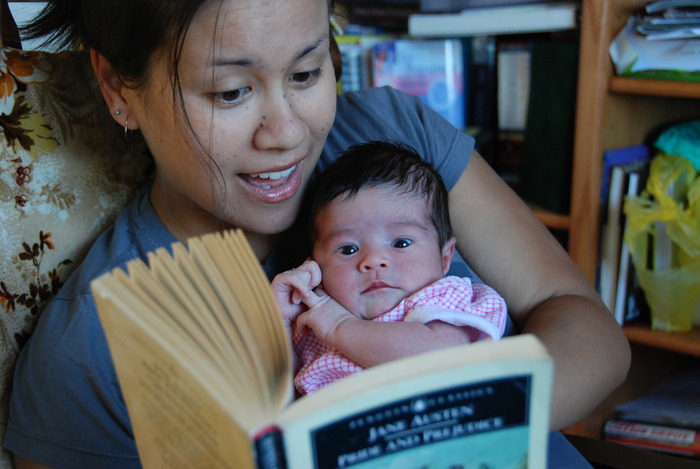
She may have been only a few days old, but my baby needed to learn the basics.

What makes a book good?
Oh man, that's an SAT question. Instead of arguing for my preferred genres, I'll categorize the basic bookshelf occupants:

Books that only entertain
Books that only teach
Books that teach and entertain

Books that invoke misguided emotions and betray morality
Books that reinforce right responses: joy in family, anger at injustice, etc.

Books that paint words as art
Books that structure grammar as science
Books that understand and respect grammar and use words artistically

Books that deceive by twisting truth, even if the content is light or spiritual
Books that speak truth, even if the content is dark or worldly

So the best combination would be . . .
books that teach and entertain, that leave you inspired and challenged, that wield the art of words, and that speak truth.

I have a lot of favorites that I believe embody this winning combination. I'm happy to share my top picks in several genres. You're invited to click on the links to read reviews I've written on Goodreads. (However, they probably all contain spoilers. You'd be better off just reading the books!)

Christian Teaching and Doctrine

The Gospel According to Jesus by John MacArthur

Biography and Memoir

Bonhoeffer: Pastor, Martyr, Prophet, Spy by Eric Metaxas
Booked: Literature in the Soul of Me by Karen Swallow Prior

Classical Fiction

Jane Eyre by Charlotte Bronte
To Kill a Mockingbird by Harper Lee

Cross-Cultural Fiction

The Poisonwood Bible by Barbara Kingsolver
A Passage to India by E.M. Forster
Caleb's Crossing by Geraldine Brooks
Cry, the Beloved Country by Alan Paton

If you'd like to know why I recommend these cross-cultural novels, I wrote a post about them on my other blog, At Home Abroad. You can read it here.


And if you'd like to read more book reviews, I'm on Goodreads! Find me there (by clicking on any of the book links above), and we'll be friends. ^^

19 July 2013

Giving Them the Gospel: Remembering Grace

Give Them Grace: Dazzling Your Kids with the Love of JesusGive Them Grace: Dazzling Your Kids with the Love of Jesus by Elyse Fitzpatrick
My rating: 4 of 5 stars

What a life changer! Well, since my life is currently focused on my young children, this book was a life changer for me. How did I not see the obvious parallel of me receiving grace from my Parent and me giving grace as a parent? It's not about eliminating discipline; instead, the book emphasizes bringing in the gospel at all opportunities, reiterating God's presence, help, involvement, etc. during great Kodak moments and also in those tough teeth-grinding moments.

As for the writing, it was extremely down-to-earth, which moms love. Don't give me romantic language or dense text when I'm probably stealing a read during nap time! Seriously, Elyse and Jessica are honest about their own methods, mistakes, and advice. They are also clear on what they think about other parenting books: They disagree with anything that doesn't emphasize the gospel. I love that. Let's not get pragmatic about parenting, meanwhile the Bible gets buried under tell-me-how-to raise-my-kids books.

Here are some noteworthy quotes:
"We are not nor can we be the saviors of our children. He is the Savior. When we forget this, our parenting will be pockmarked by fear, severity, and exhaustion."
"We hinder our children from enjoying God's embrace when we teach them that their religious activity and obedience elevates them out of the category of sinner in need of mercy."
"Giving grace to children is an exercise of faith, and faith is always more difficult than works."

I see now how my parenting was primarily LAW, and while this is necessary, it is also dangerous when divorced from the gospel. My children need to learn that they do not become "good" by obeying just like I do not become "good" by following the rules of the adult world. Romans 3:23 says "All have sinned..." and no one is declared righteous apart from Jesus Christ. This message is liberating and must permeate my being: my own self first and subsequently my relationships, my parenting.

Note: I read this book simultaneously with The Gospel According to Jesus by John MacArthur, and I totally recommend doing so.

View all my reviews

11 February 2013

A Story of Betrayal and Healing

The Painted VeilThe Painted Veil by W. Somerset Maugham
My rating: 4 of 5 stars

In languid prose, Maugham tells the story of Walter and Kitty Fane in cholera-beaten China. The novel begins with their marital rift (named Charlie) and takes the couple on a journey through harsh conditions and isolation while each decides what to do with a broken heart.

I flew through this book because of its fascinating dialogue. I felt the author created very accurate scenes of tension, passion, hatred, and remorse. As bonus, the literary reference to Goldsmith's poem takes the reader to a deeper understanding of Walter's anguish.

On the flip side, the story itself was unsatisfying. Kitty's ending resolve did not seem serious...or at least not as serious as one would expect after such a dramatic experience. Her character does not invite sympathy but rather pity. In short, you don't root for her.

Having seen the film adaptation, I must comment on its comparison here. I felt the film's plotline adjustments improved the story and rounded the characters. The ending of the film was also a solid punch in the face of Kitty's past, which brought much more resolution and closure.

So...I enjoyed the novel's dialogue, but I prefer the film's storyline.

View all my reviews

15 July 2012

Siam's Ninth Rama: Bhumibol

The Revolutionary KingThe Revolutionary King by William Stevenson
My rating: 4 of 5 stars

"We love the King!" is the motto of current Thailand, yet many do not know the background nor the struggles of their beloved monarch. Because he is considered a deity by his people, anything that may hint at flawing his image is taboo. While I agree that the Ninth Rama is extraordinary, I believe that knowing the facts given in this book would only magnify the respect and awe that his people have for him (as it has done for me).

Earlier this year, I reviewed another book on a Thai monarch: the popular memoir Anna and the King of Siam. I found that book to be outrageously condescending; however, this book by William Stevenson is written with a much more appropriate tone. He knows the king personally and conducted interviews with his family and inner court. Stevenson's personal knowledge along with his extensive experience as a journalist creates a narrative that is both respectful and thorough. He has an obvious admiration for the king; however, he doesn't deify him as the Thai people do.

As I read this book, I would bring up topics with my Thai friends and discovered consistently that they do not know these things but are interested nonetheless. Facts about the king's mother, his brother Ananda who served as the Eighth Rama, his initial struggles as a limited monarch and how he gained power and favor with his people--these are all fascinating! And of course, his story continues...

View all my reviews

Serve the Work...and Write!

Walking on Water: Reflections on Faith and ArtWalking on Water: Reflections on Faith and Art by Madeleine L'Engle
My rating: 5 of 5 stars

The humble artist will find this book a beautiful affirmation of his role in presenting truth to a world twisted by the lack of two things: imagination and vulnerability. I say "humble" because L'Engle emphasizes how the artist is serving the work, how truth emerges and the artist must write/paint/sculpt it.

L'Engle says, "The artist is someone who is full of questions, who cries them out in great angst, who discovers rainbow answers in the darkness and then rushes to canvas or paper. An artist is someone who cannot rest, who can never rest as long as there is one suffering creature in this world. Along with Plato's divine madness there is also divine discontent, a longing to find the melody in the discords of chaos, the rhyme in the cacophony, the surprised smile in time of stress or strain" (168).

I loved the connections she makes between faith and art, rendering the two virtually synonymous. Even though her writing is quite random in this book (a collection of thoughts rather unstructured), she argues adamantly for both obedience and discipline. Just as Christians are to release holds on this life and simultaneously practice self-control of themselves, artists must remember to serve the work by listening to truth while remaining disciplined with practice each day.

I need to read this book every year. ^^

View all my reviews

15 June 2012

10 Brief Christian Biographies

10 People Every Christian Should Know10 People Every Christian Should Know by Warren W. Wiersbe
My rating: 4 of 5 stars

Surprised at some negative reviews for this book (after having read it myself and really liked it), I reflected on why a series of short biographies would not be intriguing to other Christian readers. I came to the unfortunate conclusion that many believers prefer flashy, public, and radical leaders. I do not mean to convey that all present preachers are of this category, but too many do rely on fame and numbers rather than a quiet, humble faith. Those who disliked this book desired to read more of social change, large congregations, bestsellers, and giant revivals. However, Wiersbe chose 10 believers who sought God in stillness, followed His leading despite obscurity, and desired nothing of this world except the salvation of its lost. He is right to uphold them as role models, to remind us of what God desires in His children.

The book itself is an introduction to these characters. Wiersbe offers numerous references for further study and does well at encouraging readers to pursue more reading (sermons, memoirs, biographies) to challenge one's faith. The ten people are as follows:
1. Matthew Henry
2. Jonathan Edwards
3. John Henry Newman
4. J.B. Lightfoot
5. J. Hudson Taylor
6. Charles H. Spurgeon
7. Dwight L. Moody
8. Amy Carmichael
9. Oswald Chambers
10. A.W. Tozer

In *The Pursuit of God*, Tozer writes this prayer: "Be Thou exalted above my comforts. Though it mean the loss of bodily comforts and the carrying of heavy crosses I shall keep my vow made this day before Thee. Be Thou exalted over my reputation. Make me ambitious to please Thee even if as a result I must sink into obscurity and my name be forgotten as a dream. Rise, O Lord, into Thy proper place of honor, above my ambitions, above my likes and dislikes, above my family, my health and even my life itself. Let me decrease that Thou mayest increase, let me sink that Thou mayest rise above." I found this prayer to be exemplary of how these people lived their lives. If you find it inspirational, you will enjoy this book too.

View all my reviews

Un-cultured Christianity

Radical: Taking Back Your Faith from the American DreamRadical: Taking Back Your Faith from the American Dream by David Platt
My rating: 3 of 5 stars

I appreciate books that challenge my convictions, causing me to reevaluate by what standard and truths I live and to revisit their foundation in the Scriptures. I believe in the premise of Platt's argument: the American culture (its ambition and luxury) interferes with the commands of Christian living according to Jesus Himself. I'm uncertain, however, on a few of his applications, his specifics, namely in chapters 6 (on giving) and 7 (on going), which take some liberty. I understand why his audience (Americans) demand such a jolt; however, as one who already lives overseas and believes in simplified living, etc., I can see how his extreme methods may lead some away from dependence and humility and unfortunately toward self-righteous pride.

Regardless, his main point is sound, and it's a book worth reading for the very reason stated in my first sentence. Do not automatically adopt his convictions. Rather, use them to challenge you to the fervent, needed prayers: "Lord, what would you have ME do?" and "God, how would you have ME change?"

View all my reviews

01 March 2012

Preserving Paradise on Venus

Perelandra (Space Trilogy #2)Perelandra by C.S. Lewis
My rating: 4 of 5 stars

Colorful and philosophical, this book grips you if you're willing and ready to embrace difficult theology and repels you if you're looking for pure sci-fi action and simplicity. It is less about space travel--more about untainted creation, the strong arguments for rebellion, and the overarching presence and will of Maleldil (i.e. God Himself).

I read this, the second in C.S. Lewis' Space Trilogy, for the first time as a requirement in high school. Still remembering certain descriptions, I charged into it now, more than a decade later, expecting to love it as I did then. However, different aspects of the novel pierced my adult conscience, and I'm grateful that I read it at two very different points in my life. As a teenager, I was awed at the thought of innocence being above experience (of sin)--and not equated with ignorance. As an adult, I felt Ransom's frustration as he argued against the appeal of disobedience and, later, against the hopelessness of death. Obviously, the themes within this book reach readers regardless of their maturity level. So in this sense as well as in others, it is timeless.


View all my reviews

18 February 2012

A Stay-at-Home Mom's Affirmation

Home by Choice: Raising Emotionally Secure Children in an Insecure WorldHome by Choice: Raising Emotionally Secure Children in an Insecure World by Brenda Hunter
My rating: 4 of 5 stars

Stay-at-home moms: affirmation resides in these pages.

The book is packed with personal stories and extensive research that encourage any mom who decides to stay at home with her kids during those crucial first few years. I was impressed with Dr. Hunter's unswerving position as she must've known her book would invite sharp criticism and controversy. Having experienced both sides (a working mom and a stay-at-home mom), she was able to relay the research with the needed sensitivity and empathy.

I appreciated, too, how she urged women to deal with what psychological blocks may come between her and her children. Being home is not enough--you have to be there completely (physically AND emotionally). So I need to deal with my issues so they don't transfer to my kids--this can apply to a tumultuous past, a rocky present, or an uncertain future.

Toward the end of the book, she addressed a woman's reentrance into the workforce and fought against the claim that a stay-at-home mom loses too much ground in the professional world to expect more than a mediocre job upon returning to work in her late 30s or early 40s. Dr. Hunter herself battled these emotions when she was staying home and pursuing an at-home writing career instead of diving back into the workforce when her daughters entered school. Her husband encouraged her to do what she believed best for their family, saying, "But become wholehearted about your life or you will miss the best that this season of your life has to offer." Good advice!

View all my reviews

06 February 2012

An Activist Agenda in The Poisonwood Bible

Barbara Kingsolver wasted no words, symbols, or parallels in her engaging and disturbing novel about the Prices, a missionary family in the African Congo of the mid-1900s. While various themes can be raised, each points back to her central, hovering message that the Western world had imposed itself on a vulnerable and defenseless people, destroying their pure culture and replacing it with an imported ideology that can supposedly never take root in that foreign soil.

Nathan Price is the main personification of America's forceful and damaging presence. Unfortunately, he simultaneously represents a Baptist missionary, which incorrectly stains Christianity as lacking compassion. Still, the parallel of America's unswerving political views and the one-way-only doctrine of the Bible is a fair parallel. It then falters as Nathan imposes his culture on the Congolese people rather than presenting the gospel alone. 

Two vivid pictures of the novel's overall message are seen in Methuselah and Adah. The pet bird is set free only to realize his own incapability in the wild and ends up being murdered by a cat. Likewise, Kingsolver argues that the Congo was freed from Belgium only to be left susceptible to capture and rule by other superpowers. The second picture of Adah involves her healing after leaving the Congo. While many would expect her to rejoice in losing her slant and appearing normal, she says she would rather have remained Ada who could see more acutely and was completely comfortable with her crooked self. In the same way, the novel points out that the Congo did not request nor prefer democracy or capitalism and would rather have been left to its own choices, its own ways of government and economics--even if they appeared "crooked" to the rest of the world.

Sadly, the answer presented to all this corruption appears to be pantheism. Brother Fowles, the celebrated and 'successful' missionary, left the absolutes of the faith and began to worship nature as well. Orleanna dug her hands into the earth as a way of coping with the losses she endured in Africa. Adah called herself a "witch doctor," and Leah cries out to "some God" who resembles the one of Brother Fowles. This open-ended and all-encompassing religion parallels the type of tolerance Kingsolver advocates for other countries, especially those seeming to be savage and unruly. "What's right for me may not be what's right for them." However, it's when this philosophy bleeds over into morality and spirituality that all our (Christian) nerves start to fire warning shots. 

Understandably, not all of America's ways of running a country will work in an African culture; yet, does that mean they do not try to intervene at all? Where is the line between influence and imposition? The Poisonwood Bible screams that the West should keep their hands off completely, but how does that fit in with a believer's theology? 

These heavy topics are just some of what we discussed at our book club meeting on February 4. Because of her excellent narration and various perspectives, Kingsolver has written a bestseller, which definitely invokes deep thinking. While she intended it to be a political weapon, I also found it to be spiritually challenging. What a sharp stab to hear what nonbelievers will define as 'Christian.' Furthermore, her jabs at racial and cultural supremacy reminds me to remain sensitive and adaptive while living in this host country of Korea.

09 December 2011

Middle East Memoirs

In the summer of 2009, I wrote a book about our year spent in Bahrain, in the Arabian Gulf. It's a collection of short chapters, reflections of our times in church, school, out amongst Bahrainis, and also traveling to other Middle Eastern countries. It's called Pearls, Sands, and Flamboyance. This is the blurb on the back of the book:

As a young, naive teacher, Shannon Malia Heil faced didactic challenges during her year abroad in the Kingdom of Bahrain. Together with her husband Mark, she battled stereotypes, culture shock, and religious oppression while learning the value of assimilation and the power of relational evangelism. In Pearls, Sands, and Flamboyance, she captures the day-to-day life in Manama, sharing insight into their customs and lessons she gathered from her own experiences.

If you are interested or know of someone who may enjoy reading this memoir, please contact me. We have a number of copies ready to disperse, and I long for these writings to be a blessing. However, we've chosen not to advertise publicly in order to semi-control our readership and protect some of the people we know. (You may ask me about this further.) Therefore, we are asking for donations and will gladly deliver a copy to you (if you are in Hawaii or Seoul) or mail it as soon as we can.

It's been five years since we left the Middle East and two years since writing this book, but the memories are still fresh and the impressions still deep. I thank God for the experiences--good and bad--that Mark and I were blessed to have together in Bahrain.

A Slanted Memoir of Siam

Anna and the King of SiamAnna and the King of Siam by Margaret Landon
My rating: 1 of 5 stars

I now understand why this book is banned in Thailand. Anna (and Margaret Landon) elevates herself above the Siamese and belittles the king in print with childish adjectives and primitive descriptions. Rama IV, King Mongut, was an incredible ruler who ushered Thailand from the old ways into the new. Of course the country would struggle as it transitioned, as would he. Anna instead degrades him, setting herself up on a pedastle of faith and intellect. She is an ugly example of what happens when stubborn pride and superiority forbid an expat to embrace his or her host culture.

View all my reviews

26 September 2011

A Challenging Read by Ayn Rand

The FountainheadThe Fountainhead by Ayn Rand

My rating: 5 of 5 stars


Impressively crafted. Highly philosophical. Bold, clear, disturbing, and addictive.


View all my reviews

Pluralism in Eat Pray Love

Eat, Pray, LoveEat, Pray, Love by Elizabeth Gilbert
My rating: 4 of 5 stars

This brilliant narrative has the ability to woo you into its philosophies of pleasure, prayer, and balance. Be careful. If you do not already have strong convictions, Liz Gilbert will cause you to question your faith by introducing and then coercing you to embrace pluralism and a moral-free spiritualism. Her journey (emotional, spiritual, and physical) is extraordinary, yet it is similar enough to all our struggles that we can read her memoirs and still have lightbulbs blink in our heads: "Me too! Me too!" Then comes the danger of adopting her solutions along with her problems.

As a Christian, I found her book entertaining and insightful. I wanted to read it, knowing already that its views would be contrary to my own. So of course, this created bias. Still, in taking it in, I was struck with sadness over these incorrect points:
1. She is convinced that her marriage cannot be saved even though there is no abuse or adultery involved.
2. She sees no harm in leaping into another relationship as soon as she left her husband's bed...and before her divorce is near to being finalized.
3. Her spirituality does not require moral restrictions. This allows her to feel mystical and peaceful without pursuing holiness.
4. All her spiritual mentors encourage pluralism: "All religions are the same."

Eat Pray Love is another good example of how literary finesse can disguise a dangerous dogma. The concluding theme of her journey is to do what makes you most happy, pray to have inner peace, and find strength within yourself to overcome difficulty. The Bible, however, argues that we should obey God and keep His commandments, pray and study to know God more intimately, and lean on Him for strength, guidance, and wisdom. Opposites--therefore, Christianity will not fit into her pluralistic mindset.

View all my reviews

14 August 2011

Practical Advice for Moms

Loving the Little Years: Motherhood in the TrenchesLoving the Little Years: Motherhood in the Trenches by Rachel Jankovic

My rating: 4 of 5 stars


Written in a perfect form for busy moms, the book is made up of short, independent chapters. The stories have wisdom and wit, comedy and conviction.

These were the lessons I most needed:
1) Eliminate discouraging/self-pity phrases from my vocabulary, things like: "I feel overwhelmed."
2) A high-stress emotion is usually because of a number of small things. Tackle them one at a time and don't take out the tension on a disobedient or bothersome child.
3) Little girls need to be taught how to handle their emotions. It's not enough to tell them to ignore the emotions; they have to practice self-control and redirection.

The one question I'm left with is this: With 5 young children, how did she have the time to write it?


View all my reviews

08 September 2010

Beauty and Genius in The Idiot

Book Review of The Idiot by Fyodor Dostoevsky

This book reveals that power comes from two sources: beauty and genius.
Beauty is power by its sheer awe-factor. Nastasya and Aglaya are both stunningly attractive and understand the power it grants them. Yet, they are both flawed--one by experience and the other by arrogance. Myshkin, on the other hand, displayed a different kind of beauty--truth and love personified. People are awed by his goodness and cannot help admiring and following him even though they consider him an idiot.

Genius is power by its originality factor. Dostoevsky spends much time defining originality and how many people strive for it unsuccessfully. Ganya, at one point, exclaims that when he becomes rich he will become original. However, genius doesn't work that way. If you have to work to be different, to be uncommon, then you are not a natural genius. A concocted genius is a contradiction, and this paradox probably most lives out its conflict within the person himself. Myshkin, however, while perceived as an idiot, is naturally original. Others see him as unusual and foolish, but he follows no one's example as he seeks the good in people and puts his heart out to help others.

So the characters all look at the prince and see idiocy because they cannot comprehend him. They are awed by his goodness and dumbfounded by his originality...and these are the powers that build him up and eventually pull him down.

09 July 2010

Living a Good Story

Donald Miller's new book A Million Miles in a Thousand Years challenges any reader to live a better story. Through the process of editing his memoirs for a screenplay, he realized that the elements of a good story are also the makeup of a good life. Reading through his discoveries and how he began to live out these new convictions brings a powerful charge.

A good story includes risk. It includes a character who is intentional. It includes change brought about through suffering.

Many people are afraid of all three of these. Many people dream of having a good story but live each day as if it doesn't matter.

If a producer came to you and said he wanted to make a movie about your life, would you be able to relay events that show you were not controlled by fear, apathy, and/or laziness? Would your story show courage, faith, and obedience to God?

Needless to say, I recommend this book. And I recommend the life change advocated in it.